How to combine ‘blw’ and purees: the combined approach
When weaning your baby there are many different opinions and methods. In this blog, I share my experience with How to combine ‘blw’ and purees with the combined approach using elements of spoon-fed and baby-led weaning.
Let’s start with a disclaimer: I am no medical professional. I am a mom sharing what I learned using the combined weaning approach. To be honest, when I started I didn’t even know that there was a name for what I was doing. But I learned quickly what worked and also what I would do differently the next time around.
What is spoon-feeding and baby-led weaning?
There is more than one good feeding method on how to wean a baby. Today I introduce you to 3 different approaches. The two most known are spoon-feeding and baby-led weaning.
Spoon feeding generally starts at 4 months of age when babies start eating fruit and vegetable purées. Some people think that spoon-feeding means that babies eat baby purees for up to one year. That is not the spoon-feeding approach. If you follow the spoon-feeding approach, babies will get purées with lumpier pieces at 7 months of age. From 8-9 months they will get purées with additional finger foods. They should be able to completely feed with finger foods when they turn 1 year old.
Baby-led weaning also called blw approach usually starts around the 6-month mark. It generally means that you give your baby finger foods from their very first bite. The baby stays in full control of which food they pick up and place in their mouth as well as how much they eat. For mushier foods like mashed potatoes, the spoon is loaded by the parent. The baby takes the pre-loaded spoon and eats with it.
What is the combined approach?
The combined approach uses elements of the spoon-feeding approach as well as elements of baby-led weaning. You can choose to feed certain meals with a spoon and for other meals let your baby eat finger foods. You can also choose to feed certain foods with a spoon and others as finger food.
But be careful: many parents say that they do ‘ a bit of both’ or the combination approach when they are following the traditional spoon-feeding approach as summarized above. If you let your baby feed from finger foods and then always top off the meal by spoon-feeding until they are ‘full’ you might be simply following the spoon-feeding approach.
Some people even say that there is no such thing as a combined approach since the baby’s leading is only possible with total control of the baby. I think that you can incorporate elements of baby-led weaning even if you occasionally choose to spoon feed too. If you want to incorporate elements of the baby-led weaning approach the baby leading is key. Trust your baby that it knows best when she’s full.
When to start weaning with the combined approach?
The World Health Organization recommends starting weaning not earlier than 6 months. They argue that breast milk (or baby formula) is the most nourishing food a baby can eat. And when you think about it: breastmilk contains many more calories than most purées for 4-month-old babies, especially vegetable purées. This research shows no difference in growth, body mass index or deficiencies between the introduction of solids between 3-6 months or later. Exclusive breastfeeding until 6 months showed to have lower infection rates among babies.
On the other side, this research shows that babies tend to have fewer food allergies if they are introduced to allergens early at around 4 months of age. I think the benefits of waiting are greater than the risks of allergies. Especially if you introduce common allergens before 8 months of age.
Whatever you choose watch for the signs of readiness to wean in your baby. Possible signs of readiness are:
- Shows interest in food or watching other people eat
- Control of head and neck.
- Sits alone or with support.
Why did weaning with the combined approach work for us?
As you can imagine there are different pros and cons of all methods. Combining both spoon-feeding and baby-led weaning was for us the most convenient approach in different situations. Here are my top pros and cons for both spoon-feeding and baby-led weaning.
Pros of spoon-feeding
Let’s start with the pros of spoon-feeding. If you speak to a pro blw person it might seem that this is the only good approach, but there are benefits of traditional weaning. At least where I live spoon feeding is more common, especially amongst the generation of my parents. Therefore I don’t get any negative comments on what I am doing when I spoon-feed.
Another pro is that you can prepare purées in advance for many weeks and freeze them in small portions.
And let’s state the obvious: there will be less mess and therefore also less waste of food.
Cons of spoon-feeding
The cons of spoon feeding in my opinion are that on-the-go feedings need a whole installation. I need a bib, spoon, and the purée that also shouldn’t get too hot for too long, or otherwise it goes bad.
When we were hiking I gave my baby a fruit purée. She needed to sit in my lab and of course, she started grabbing the spoon, and the fruit, and smearing it all over my clothes. If you do baby-led weaning you can choose drier finger foods as bread which makes eating much easier.
Another con of spoon feeding is the fight about the spoon. Likely your baby wants to grab the spoon herself and not giving it to her can lead to frustrations – on both ends. It might help to give the baby an empty spoon to distract him. But in my experience then there is a fight between two spoons and one little mouth.
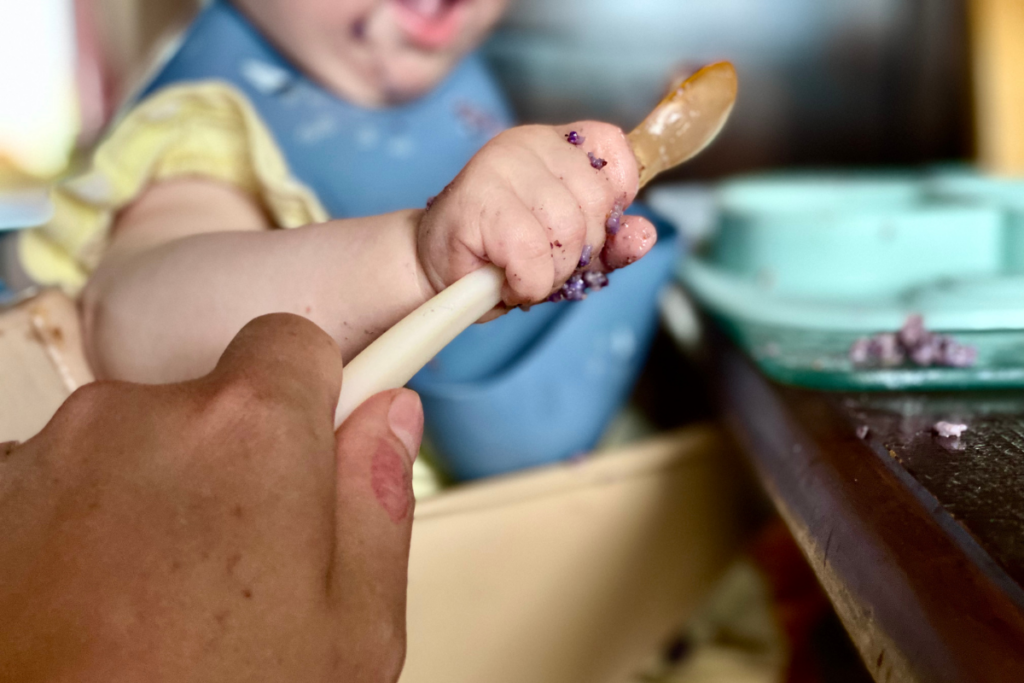
Something that I hear often as a pro of baby-led weaning is that I don’t have to prepare purées. And surely preparing purées is a con of spoon feeding. But baby let weaning is not always as easy as it sounds.
If our baby can eat what we eat there is no extra cooking. But sometimes we enjoy meals where there is naturally too much salt or sugar added or there are too many components not fit as baby foods. Some foods e.g. raw carrots are simply not chewable for a little baby.
With the months of us using this approach we learned how to cook our meals smart. It probably even gave a boost to our healthy eating habits which would count as the first pro of baby-led weaning. That way there was not too much extra work but we always can offer our little one enough choice that is eatable for her.
Pros of baby-led weaning
The big pro of baby-led weaning for me is that you don’t have to actively put food into your baby. Family meals are much more relaxing for us when we choose a baby-led weaning meal. You simply sit together as a family and eat, everyone on their plate.
Another pro I hear a lot is that the baby is less likely to overeat when she has total control over what goes into her mouth and what does not. There might be truth to that in some babies. However, our girl showed very clear fullness cues. She would simply not take anything from the spoon or start spitting it out again.
And at the other hand, I sometimes felt that she wanted some more food, but not the lumpy things we were offering her. My advice is to no matter which approach you choose listen to your gut and your baby’s cues. Whatever feeding method you choose try to implement responsive feeding where you watch the cues your baby gives you.
A big pro of baby-led weaning is its influence on picky eating. According to this study children that were introduced to lumpy foods before 9 months of age had significantly fewer eating problems at age 7 than children who were introduced to lumpy foods after 9 months of age.
Another pro is that you learn much better to trust your baby with their choice of food. I used to worry if she would get enough or not since we started weaning. Using the baby-led weaning approach I simply trust that she can grab as much or as little as she wants at her own pace.
Even though I don’t have a study showing this clearly I felt that the fine motor skills of our baby developed rapidly after we introduced more baby-led feeding.
Cons of baby-led weaning
For me, the biggest cons of blw were also the reasons why we actually choose to spoon-feed from time to time. When we are at a restaurant there is mostly little to no food on the menu that our baby can eat. Therefore I take something with me I can spoon feed her or something she can easily eat herself.
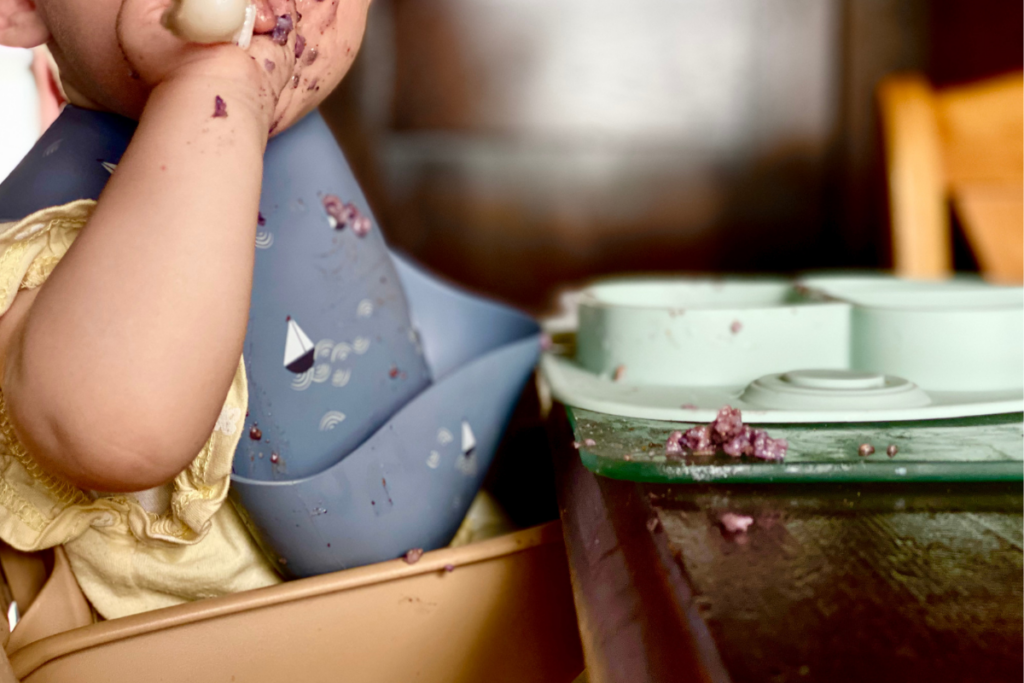
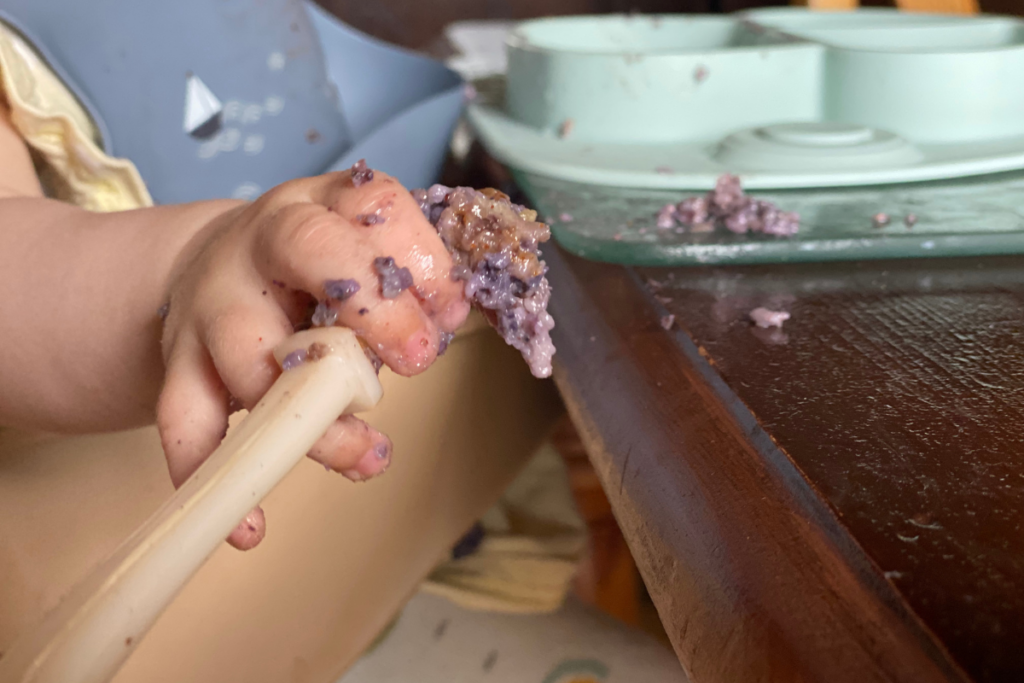
A big con is that baby-led weaning can get very messy. This is not such a big con for us when we are at home. The time I need to clean up the mess is much less than the time I need to spoon-feed our baby. But when we are at other people’s homes I don’t always feel free to let our baby do her thing as freely as at home.
Some people experience a lot of gagging with baby-led weaning. Research shows that babies that eat solid foods from 6 months onwards don’t have a bigger risk of choking. However, gagging also doesn’t look that nice even though babies often don’t seem to be in too much discomfort. Our baby didn’t gag at all. She learned, in the beginning, to give foods back out that were too big to swallow. So it might be a con for some but not for all.
How our weaning with the combined approach looked likes
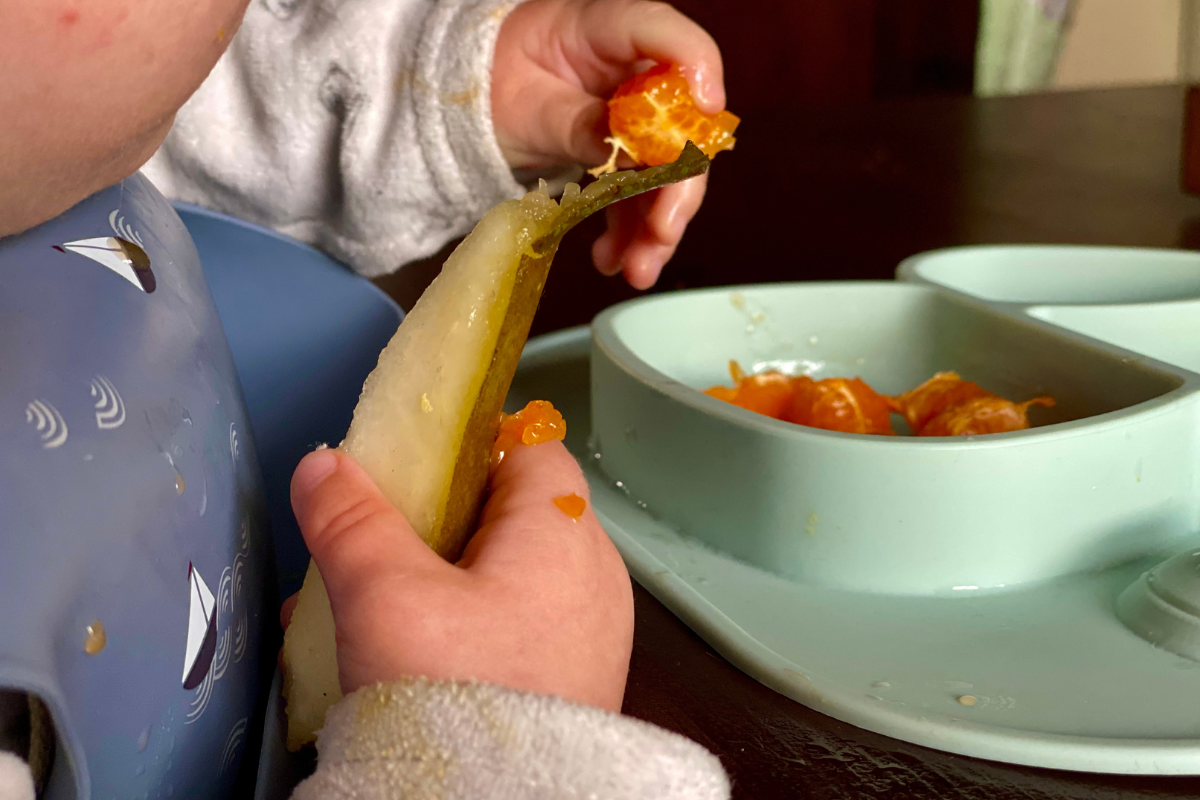
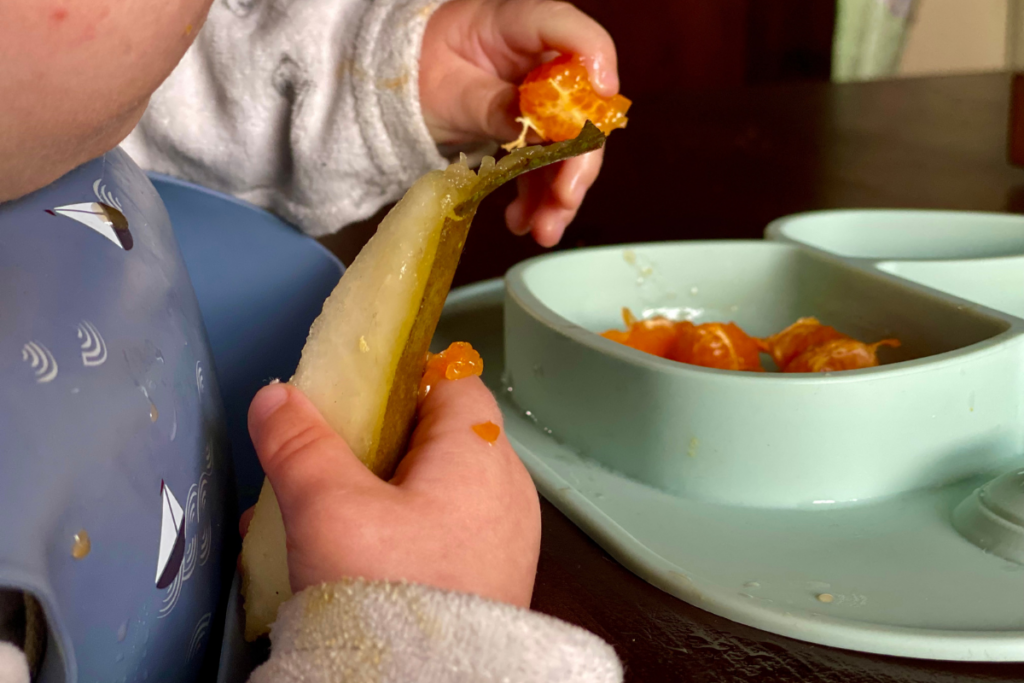
We started weaning at 6 months and offered our baby 9 out of 10 meals with different table foods. We started with small pieces of soft fruits. When we offered her yogurt we chose to spoon-feed them ourselves most of the time and only sometimes offered her preloaded spoons to eat them. All other mushier foods she eats herself. I am working with her on the 100 food challenge. That means that I offer her 100 new foods (ingredients) before she turns 1 year old.
When we are at other people’s homes we often choose to spoon feed. That strongly depends on what our hosts are cooking and therefore what I can offer our baby girl. Another factor is if I feel comfortable and if there is enough space to make a mess.
When we were on vacation with our tent we chose to almost exclusively spoon feed for 3 weeks straight. Our baby used to through food to the floor a lot and as we were eating outside in the woods there was no possibility to pick things up again.
All in all, we enjoyed it so much seeing our baby eating. We sensed that she doesn’t dislike foods or textures as long as we offer them often enough. For us using elements of both the traditional method of spoon-feeding but also the more modern baby-led approach was the best approach we could have taken. That way we could make use of the benefits of both approaches.
What will I do differently next time?
Even if I felt fairly well prepared I learned so much when it comes to weaning with a combined approach. Those three things I will do differently or implement right from the beginning next time around:
- Trust the process, don’t top off with traditional spoon feeding
- Advocate for your feeding choices even if it is messy
- Invest in different textures and shapes every meal
Our baby lost some weight when we started weaning. Looking back that is totally logical since breastmilk is pretty nutrient-dense. I thought that the amount of food she ate was not enough and tended to top off her meal with some spoons of something when I felt like she didn’t eat enough pieces of food. I quickly learned that even if she didn’t eat any finger foods in one meal she would eat more the next meal and even day.
Being the first in my circles starting with baby-led weaning I faced different opinions about it. Some were worried about choking hazards but most were commenting about the mess. I tended to agree with them since I annoyed myself about the mess as well. Lately, I started realizing that I didn’t have to be annoyed by my baby exploring her food and that I could stand up to her doing so to others.
When we just started with weaning we offered our baby mostly one food at a time. As the months pass I observed that if she has three or more foods to choose from she more likely ends up eating something. the months pass I observed that if she has three or more foods to choose from she more likely ends up eating more.
Introducing water to your baby
(Too much) water can be dangerous to small babies so always speak to your care provider about the introduction of water.
Babies should drink breastmilk (or baby formula) as long as possible. However, with the introduction of solids it is good to at least offer them a cup of water every meal. In my experience, your baby will primarily drink breastmilk for much longer than 6 months but it is good for them to learn about the taste of water along with solids.
You can give your baby teas instead of water alongside their meals but try to give them water as often as possible. In the long run that is what you want them to drink. Don’t give them any sweetened drinks at all (also no juices) for as long as possible but at least for the first year of their lives.
As with everything routine is key. Read more about my morning routine as a first-time mom and how you can hydrate yourself as well as your baby first thing in the morning!
What will you need to get started?
No matter which approach you end up choosing for your family I can really recommend you get the following items to prepare for your weaning journey:
- Baby chair that will grow with your child
- Baby spoons
- Baby plate (silicon with suction)
- Leak-proof baby cup
- Silicon bibs
What are your experiences with weaning? Do you like weaning with the combined approach? Write a comment, I would love to read all about it!