My positive induction story with epidural (42+ weeks)
In this blog, I’m sharing my positive induction birth story at 42 weeks and 2 days pregnant with an epidural. I talk about my experience with a post-term pregnancy and how you can view your birth positively, even when things don’t go as planned.
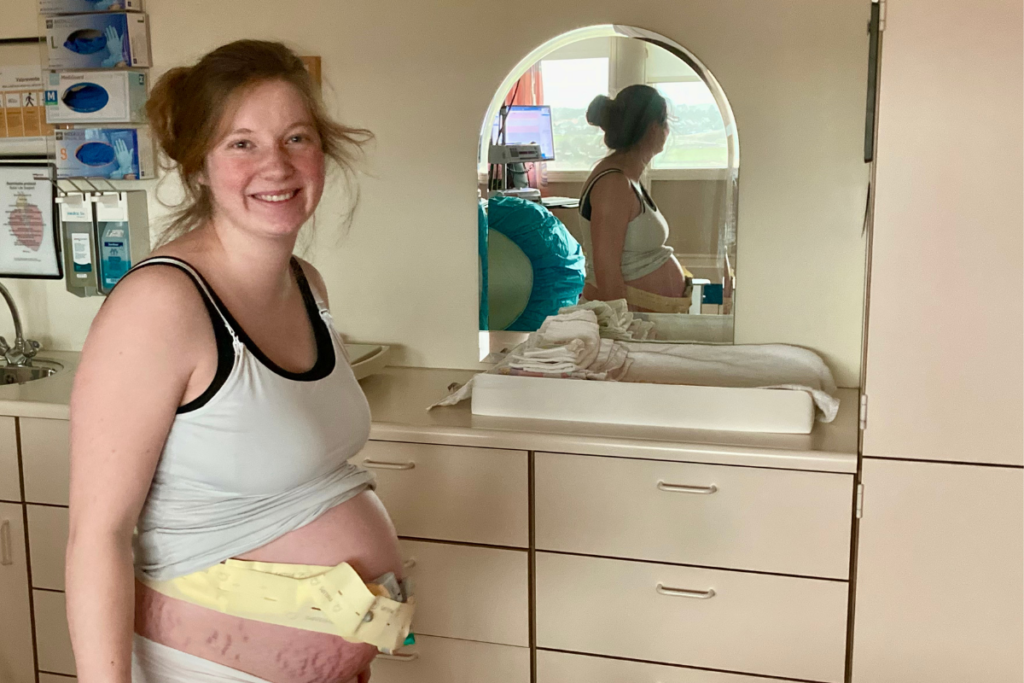
Why I Chose to Wait for Induction at 42 Weeks and 2 Days
First things first: Why did I choose to wait for an induction for so long? In the Netherlands, inductions are recommended at 42 weeks of pregnancy for uncomplicated pregnancies. From 41 weeks on, you can opt for an induction without a medical reason. Initially, we planned to follow this recommendation.
When it came time for my induction, I decided to wait an extra two days. I wanted to give my body time to prepare for birth naturally especially since it was my first pregnancy. Even now, I’m unsure if my due date was set a bit too early. My cycles were regular, but longer than 28 days, and I was surprised my due date was chosen so soon.
Is it safe to wait until 42 weeks to get induced?
A quick disclaimer: I’m not a medical professional. Always consult your care provider about your personal situation.
A study looked at the risk of stillbirth in longer pregnancies. The risk of perinatal deaths is 0.06% at 41 weeks and increases slightly to 0.11% at 42 weeks. While this may sound alarming, the risk remains very small either way.
Stillbirths aren’t the only concern when it comes to pregnancy length. Infant death is another important risk to consider. According to the same study, infant death rates are highest (among full-term pregnancies) at 37 weeks and lowest at 39 weeks. After 39 weeks, the risk increases slightly each week until 42 weeks, but the differences are minimal.
Since inductions are typically recommended by 42 weeks, there is limited data on longer pregnancies and it’s risk factors. In my grandmother’s time, ultrasounds didn’t exist to determine due dates. People didn’t know exactly when their baby would arrive. If the baby didn’t come, you simply waited. I’ve heard stories of women being pregnant for over 43 weeks back then—something that rarely happens today. But even with ultrasounds, due dates are estimates, which is why there’s such a wide window for when babies are born.
Since there were no other medical reasons to start the induction process present for me (such as gestational diabetes or high blood pressure) we decided to wait for spontaneous labour.
Can I Decide Not to Induce When My Care Provider Recommends It?
The simple answer is: Yes, you can. Inductions aren’t always medically necessary. For example, some providers may suggest induction due to a “big baby” or even to ensure the baby is born before their vacation! It’s important to ask your care provider why they’re recommending an induction and what the risks are if you decide to wait a bit longer. A good provider will give you numbers to help guide your decision. Remember, induction is a personal choice. No one can force you to make any decision regarding your birth.
If there is a medical reason for induction, your baby or you might be at risk if you wait. But induction also carries its own risks. A study that observed over 450,000 births over 15 years found that babies born through induction faced higher risks of birth trauma after induced births (e.g., broken bones), respiratory issues, and even the need for resuscitation. Moms who were induced were more likely to have an instrumental birth, or an episiotomy, ask for an epidural, and experience heavier postpartum bleeding.
Was It Easy for Us to Wait Until 42+2 Before Getting Induced?
Of course, it wasn’t easy! No one wants to feel like a round whale for that long. The last weeks of my pregnancy were nerve-wracking. At 40 and 41 weeks, people asked every single day if the baby had arrived yet. Pro tip: If you’re on the other side of this, please, never ask expecting parents that question repeatedly! My poor husband had to answer again and again that the baby was still not here and that he’d let everyone know once it happened.
What made it even more frustrating was that we expected our baby at the end of 2023. So, even though it was only 2.5 weeks past the due date, it felt like the due date was from a lifetime ago. It seemed like everyone in our village, church, family, and even extended friends was holding their breath, waiting for our baby to arrive.
We visited the hospital almost every day leading up to the induction to ensure the baby was still doing well. While inconvenient, it gave me peace of mind knowing everything was okay. So, we never really worried about our baby’s safety in my womb.
Contractions Before Labor: A Waiting Game
Since week 32, I had Braxton Hicks contractions pretty often. By week 39, I started having real contractions from time to time. I even experienced false labor twice, with contractions coming every 5 minutes for hours, only to stop again. We were all so sure that the baby would come soon, maybe even the next day—but she didn’t!
What I Tried to Induce Labor Before 42 Weeks
Honestly, I feel like I tried everything to get labor going before 42 weeks. Here’s a list of things I did to try to get things moving:
- Eating dates (Fun fact: I ate 4 kg of dates from 37 to 42 weeks!)
- Drinking all kinds of teas
- Going for walks
- Taking rest
- We even tried the deed (at 42 weeks!)
- Nipple stimulation
- Miles circuit
- Membrane sweep (which didn’t work due to no dilation)
- All sorts of exercises, including the one where you hang with your head down from the sofa
- Limiting sugar intake from 37 weeks onward
- Taking warm baths…
Let’s state the obvious: nothing worked for me. If you’re sitting there with your big belly and see 100 comments under a YouTube video from people who went into labor immediately after doing this or that, just know: you are not alone.
My Positive Induction Story: The Morning of the Induction
We finally decided to go for an induction at 42 weeks and 2 days. On the morning of the induction, I woke up at 6 a.m. with mild contractions every 5 minutes. We decided to head to the hospital anyway, just in case, even though they could have been false labor again.
We packed everything into the car and left our home, knowing we’d return with the three of us. I remember feeling so nervous about forgetting something or arriving too late, even though we had everything we needed for our birth. After all those weeks of waiting, we had prepared well enough to bring everything we wanted along for the journey.
My Positive Induction Story: From 0 to 3 cm Dilation with the Balloon Catheter
After listening to our baby’s heartbeat for a while, the induction started with the Foley balloon. This tiny balloon is inserted into your womb to apply gentle pressure on your cervix, helping to start contractions. Around 10 a.m., they placed the balloon. I immediately started having regular contractions every 4 to 5 minutes, and they were actually making progress.
By just after 12 p.m., the balloon was removed, and I was dilated to 3 cm! I worked through the contractions in the bathtub, and I was actually surprised by how nice it felt to see things progressing so well. It gave me hope for a smooth, natural birth with my first baby.
My Positive Induction Story: Breaking the Water
We waited for several hours, and while I kept having contractions every 4 minutes, they weren’t strong enough to efface or dilate my cervix further. The midwife suggested breaking my waters, and after some thought, my husband and I agreed to do it around 2:30 p.m. Unfortunately, it didn’t have the desired effect on effacement or dilation. My OB-GYN later told me that the artificial rupture of membranes typically has a low chance of working during your first labor. However, it’s more likely to help in second child or subsequent labors.
Since my baby had pooped into the amniotic fluid (which is common at 42 weeks), losing amniotic fluid constantly wasn’t ideal. The midwife also advised against using the bathtub anymore due to infection risks, even though my contractions became more intense after my water broke.
Looking back, I would consider breaking my water for a second birth but knowing what I know now, I probably wouldn’t choose to do it for my first.
My positive induction story: starting with oxytocin
The whole afternoon and evening, contractions came every 3 to 4 minutes for the whole time. They were strong enough that I couldn’t talk through them, but sadly, my cervix wasn’t changing. At 8:30 PM, a new midwife from the night shift began the hormone drip with oxytocin. I noticed the contractions picked up, and within an hour, they told me after the cervical check that I reached 4 cm. Unfortunately, after that, progress stalled.
I tried using the exercise ball, hoping it might help. But even though the contractions were strong, my cervix didn’t respond as hoped. It was a long story, filled with moments of waiting and hoping.
In the end, the overall result was an induced birth with a slow start. I was given a dose of pictocin, which helped, but the process took longer than expected. Even so, I know I gave it my all. To anyone going through this, I wish you the best of luck with your own journey. You’ve got this!
The Best Choice: My Epidural Experience
At 10 p.m., I began exploring my pain relief options. By this point, I was exhausted and in a lot of pain. It wasn’t so much that I couldn’t handle it, but it felt pointless to keep enduring pain without any progress in dilation or effacement. I wanted a natural labor, so we decided to wait a bit longer. It was very unfortunate that the hospital didn’t provide a tens machine. By 12 a.m., with no changes, I asked for the epidural.
I felt sad at first, as I had dreamed of a natural birth. I knew the potential risks and was worried that it might lead to a cascade of interventions. But looking back, choosing the epidural was definitely the best thing for us in that moment.
At 1:30 a.m., I finally got the epidural, and wow, what a relief! My husband and I still laugh at how quickly my mood changes. I was so happy to be free from the pain the first time in hours of contractions that I started saying all sorts of silly things to the doctor and nurse. I asked them about their job and education, and we had a fun chat. I even got a water ice right there in the anesthesiology room!
Even though I initially wanted a natural labor, I can honestly say the epidural was the right choice for me at that time. We were lucky that, despite the increased risk of complications, our baby’s heart rate remained stable, and the dose of Pitocin didn’t need to be increased much.
My Positive Induction Story: The Moment I Reached 10 cm!
At 2 a.m., I was in the labor and delivery department, and I had already reached 5 cm. Since my contractions had weakened a bit from the epidural, I needed a slightly higher dose of oxytocin. Thankfully, this was the only intervention needed for the rest of my labor. My baby’s vitals and mine stayed stable, and my contractions didn’t slow down.
Even though I couldn’t feel the pain of the contractions, I could still feel the pressure and my baby moving constantly. I couldn’t sleep, but at least I managed to get some rest. Around 4:30 a.m., it felt like the baby was about to fall out! I wasn’t sure if I had even pooped myself, and I’m still not sure to this day! The pressure was intense, so I called the midwife. They told me it would likely still take a while to reach 10 cm. But to my surprise, after a vaginal examination, they found I was ready to push!
The Push That Brought Our Baby Girl Into the World
They lowered my epidural dose to the minimum so I could feel the contractions clearly, and we waited almost an hour until I could push effectively.
I ended up pushing for 1.5 hours until our baby girl, Hannah, arrived. Even though I could feel the contractions more now, it was so exciting to finally push. The end was in sight!
The midwife instructed me to push while holding my legs up, but it didn’t feel comfortable for me. I knew it wasn’t the most ideal position, so I switched to all fours. I pushed for 20 minutes in that position, and it felt much better. Eventually, I lay on my side, which turned out to be the most productive position. That’s where my baby’s head emerged, and she was born!
As we neared the end, I heard that the baby’s heartbeat wasn’t as stable as it had been. They called the doctor, but luckily, our baby girl arrived just in time, and no instruments were needed.
At 7 a.m. on the dot, our daughter, Hannah, was born. We had a beautiful golden hour with her, lasting about 2.5 hours, as the night shift changed to the day shift. After that, our baby girl was weighed, and I was stitched up.
Labor Positions That Made My Induction Journey Easier
The birth ball was a game-changer for me when dealing with labor pain. My husband encouraged me to change positions every 30 minutes or so. I labored on all fours, laid on my side to rest, stood, walked, and sat on the birth ball.
During early labor, the bathtub was a huge relief. Later on, I tried the shower, but it wasn’t the right fit for me. I followed the advice to avoid lying on my back during labor, even after I had the epidural.
In my birth class, I learned about the peanut birth ball. I requested one, and it helped me lie on my side with the ball between my legs. It kept me open and worked with gravity, not against it.
Looking back, the whole experience was unique, and these positions really helped me manage the challenges of an induction.
Our Birth Plan vs. Reality: Embracing the Unexpected
My husband and I had planned for a natural home birth with as few interventions as possible. However, things didn’t go exactly as we envisioned. We ended up in the hospital, induced, and with an epidural. So, I’d say that our birth didn’t quite follow the plan!
Here are some tips for creating a birth plan that can support you, no matter what type of birth you end up having:
- Cover different scenarios – Include options for home birth, hospital, instrumental birth, and even c-section.
- Focus on what you can control – Think about things like the number of people in the room, rather than outcomes like a vaginal birth.
- Let go of unrealistic expectations – You can’t truly plan birth, so aim for flexibility.
- Communicate your plan – Make sure your care provider receives your birth plan when you go to the hospital. It may sound simple, but many plans never reach the midwives or doctors!
- Discuss with your partner – Be sure you’re on the same page so they can advocate for you if needed.
In the end, we made the right decision for our situation, and it turned out to be a great experience, even if it wasn’t what we expected.o the midwifes and doctors! Share your plan with your partner as well. Make sure that you are on one page before your birth. That way your birth partner will be able to advocate for your wishes even if you are not able to do that yourself.
Looking Back with Positivity: Tips for a Better Birth Experience
Even though my birth was much different from what we had envisioned, it still feels like a good experience. Two key factors made all the difference:
- Adjusting Expectations – My birth plan and expectations were flexible, with options for different scenarios.
- Educating Ourselves – My husband and I took the time to learn about birth beforehand, which helped us feel like we were making choices instead of things just happening to us. Don’t skip the part of educating your birth partner since he will be advocating for you during the process.
Though my birth plan didn’t specifically mention induction, I did prepare for a hospital setting just in case. I wrote down a few preferences, like requesting as few cervical checks as possible. The midwives respected this by always asking if I was okay with a check or if I’d prefer to wait. Even these small gestures made me feel heard and respected, even though the birth didn’t go as planned.
Because we educated ourselves about birth, and especially about induction, we knew what to expect. When interventions came up, we understood their purpose and felt empowered to make decisions together. I believe that feeling in control of the situation really shaped our satisfaction with the experience. If you feel like you’re choosing what happens, you’re more likely to feel happy with the outcome.
Here are my tips:
- Prepare for multiple scenarios – Have a flexible birth plan that accounts for different possibilities.
- Educate yourself and your partner – Knowledge will help you feel in control throughout the process.
What I Learned From My Positive Induction Story
Before becoming a parent, I thought if I followed a certain plan, I could control the outcome. But my birth story taught me an important lesson early on: even when you do everything you can to achieve a specific outcome, things can still turn out differently. And that doesn’t always have to be a bad thing!
I want to encourage you to trust the process of bringing new life into this world. It might unfold exactly as you hoped, or it might go in an unexpected direction. Either way, you’ll walk away with a beautiful baby and valuable lessons along the way. I’m sending you my best wishes and God’s blessings for your birth. You’ve got this, mama!
What’s your experience with induction? Do you have any thoughts or questions about it? Please leave a comment – I’d love to hear all about it!